Business Cycle Fund-What You Need to Know
What is Business Cycle Fund
- The business cycle is the regular pattern of ups and downs in economic growth over time.
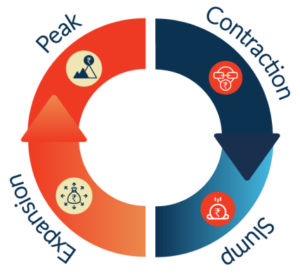
- It has four main phases: Expansion (when the economy grows), Peak (when growth is at its highest), Contraction (when growth slows down), and Slump (when the economy is at its lowest).
- Each phase impacts different parts of the economy in different ways.
- Investors can use these cycles to find opportunities and manage risks.
The Business Cycle explained
Every economy, regardless of location, typically experiences four distinct phases of the business cycle:
1- Expansion Phase
This phase, known as the recovery phase, follows an economic downturn. During this period, economic activity begins to rebound, with GDP expanding, unemployment declining, and consumer spending rising. As a result, business sales and profits grow, fostering a positive investment outlook in the stock market. Additionally, interest rates tend to be low, and monetary policy is supportive, making credit more affordable and accessible, which further encourages investment and stimulates economic growth.
2- Peak Phase
In this phase of the business cycle, economic activity reaches its highest point. Both investment sentiment and consumer confidence are strong. Growth hits its peak, and key economic indicators like GDP and prices remain steady for a time before eventually starting to decline. At this stage, the central bank may consider raising interest rates to manage rising inflationary pressures.
3- Contraction Phase
This phase typically signals the onset of a recession, as the economy begins to contract. It’s characterized by negative GDP growth, rising unemployment, and a drop in consumer spending. Business profits decline, leading to a more cautious and subdued investment sentiment. During this phase, market volatility often intensifies.
4 - SlumPhase
The slum phase marks the bottom of the business cycle and extends from the contraction phase. It represents the lowest level of economic activity, where spending and income remain stagnant at their weakest points.
How to Identify Business Cycle
Business Cycle in Growth Phase
- Consumer and businesses feel confident
- Factories run at full capacity – 3 shifts
- Business Plan expansion
- Employees have multiple job offers, Salary hikes
Business Cycle in Slum Phase
- Consumer & businesses nervous. Postponing Spending
- Factories have idle capacity. Not operating all shifts
- Busiess Cutting cost and capex
- Layoffs and salary freeze
- Consumer opt for spending cuts
Why does the business cycle matter to investors?
Here is why it is important for you to understand the business cycle:
Timing of investments
The business cycle helps investors understand the different phases of the economy: expansion, peak, contraction, and slum. Each phase has unique characteristics that can greatly impact investment returns. By recognizing the current phase, you can make better investment decisions. For instance, during an expansion, it may be wise to invest more in stocks, while in a contraction, it could be safer to increase investments in defensive assets like bonds or cash.
Sector rotation
Various sectors perform differently throughout the business cycle. For example, technology and consumer discretionary sectors often do well during expansion, while utilities and consumer staples tend to outperform during contractions. Understanding these patterns allows you to apply a sector rotation strategy, where you adjust your investments to focus on sectors expected to thrive in the current economic phase.
Risk Management
The business cycle offers valuable insights into the broader risk environment. During economic expansion, investors are generally more willing to take on risk, while during contractions, they tend to be more cautious. By aligning your investments with the current stage of the business cycle, you can adjust your risk exposure—reducing potential losses during downturns and seizing opportunities during periods of growth.
Long-Term Planning
Understanding the business cycle encourages a long-term investment approach. Since expansions and contractions occur over extended periods, recognizing these patterns helps you craft strategies that accommodate each phase of the cycle. This way, you can avoid rash decisions based on short-term market changes and stay focused on achieving your long-term goals.
| Scheme | AUM |
|---|---|
| Axis Business Cycle Fund | |
Who should Invest in this Fund?
Diversify Seekers
who actively looks to spread their investments or resources across various areas to reduce risk and increase potential returns
Patient Investors
someone who adopts a long-term approach to investing, willing to hold onto investments through market fluctuations and avoid reacting to short-term volatility
Risk Tolerant Individuals
someone who is willing to accept higher levels of risk in their investments in exchange for the potential for greater returns
| Scheme Name | AUM |
|---|---|
| ABSL Business Cycle Fund | 1,880 Cr |
| Axis Business Cycle Fund | 2841 Cr |
| Bank of India Business Cycle Fund | |
| Baroda BNP Business Cycle Fund | 619 Cr. |
| Edelweiss Business Cycle Fund | 1770 Cr |
| HDFC Business Cycle Fund | 3150 Cr |
| HSBC Business Cycle Fund | 977 Cr |
| ICICI Prudential Business Cycle Fund | 11215 Cr |
| Kotak Business Cycle Fund | 2715 Cr |
| Mahindra Manulife Business Cycle Fund | 1146 Cr |
| Motilal Oswal Business Cycle Fund | |
| Quant Business Cycle Fund | 1594 Cr |
| Sundaram Business Cycle Fund | |
| Tata Business Cycle Fund | 2866 Cr |
| Union Business Cycle Fund |
Also read: types of mutual funds