
How to- Process for checking your KYC status
Why KYC is Important
KYC is a one-time process in the securities market. Once completed with a SEBI-registered intermediary, you will not need to repeat it when you engage with a new broker, mutual fund, or other authorized entity.
What is KYC?
The abbreviation KYC stands for “Know Your Customer”. This process involves verifying your identity and address.
KYC or Know Your Customer is a reliable method for institutions to validate and authenticate a customer’s identity.
To invest in different financial instruments, the customer needs to furnish all the essential KYC documents.
The Reserve Bank of India & SEBI mandates all financial institutions to conduct the KYC process for all customers before allowing them to carry out any financial transactions.
The customer can choose to complete the KYC verification online or offline, as it is a straightforward one-time process.
Type of KYC
There are two types of KYC verification processes available, and both are equally effective. The choice between the two comes down to personal preference and convenience. The two types are as follows:
Aadhar base KYC- This verification process is done online, making it highly convenient for those with a broadband or internet connection.
To complete the KYC process, customers need to fill out their details online, including their Aadhar details. Once the details are submitted, an Aadhar OTP is sent to the customer. Upon entering the OTP, the KYC process is considered complete.
In-person Physical KYC - For in-person KYC verification, customers need to visit the institution where they conduct financial transactions.
They must fill out the KYC form and attach a photo, address proof, and PAN card. Finally, they need to sign the form to complete the process.
List of KRA - KYC Registration Agency
- CDSL Ventures Ltd (CVL), a subsidiary of the Central Securities Depositories (India) Limited
- NSDL Database Management Limited (NDML), a subsidiary of the National Securities Depositories (India) Ltd,
- The National Stock Exchange’s agency - NSE Data & Analytics Limited,
- BSE Technologies Pvt Ltd
- CAMS Investor Services Private Limited
- Karvy Data Management Services Limited (KDMS)
NSE KRA - KYC check
[
BSE KRA - KYC check
https://www.bsekra.com/kycenquiry.html
CAMS KRA - KYC check
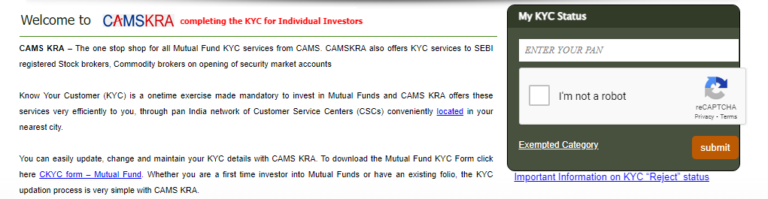 :**
:**
- Mobile number and email ID: While not mandatory, including your mobile number and email ID in your KYC application is highly recommended. This allows for faster communication and verification.
- KYC Validation: SEBI requires KYC details to be validated using Aadhaar data (if provided). This includes your name, photo, address, and gender.
- KYC Status and Investment: You can invest in mutual funds only after your KYC status is validated (code ‘07’). If you used Aadhaar for KYC, ensure your status is updated from “In Progress” (code ‘01’) to “KYC Validated” before initiating transactions.
- KYC Identifier: PAN and PEKRN (for PAN-exempt cases) remain your KYC identifiers.
Overall, the KYC verification process is designed to ensure that organizations comply with legal and regulatory requirements, and that they know who their customers are to help prevent fraud and money laundering.
What is First Holder KRA Status?
First Holder KRA Status refers to the compliance status of the primary applicant (the first person named) on a financial account (like a Demat, trading, or bank account) with India’s KYC Registration Agency (KRA).
Think of the KRA as a central library that stores your verified identity and address proof. Financial institutions (like your bank or broker) check this library to avoid doing the same KYC verification repeatedly.
- “First Holder”: This is you, the main account owner. If it’s a joint account, you are the first name on the account.
- “KRA Status”: This is a simple flag that tells your bank/broker if your KYC documents are verified and registered in the central KRA system.
Common KYC Status & What They Mean:
NOT AVAILABLE: Your KYC may not have been uploaded to the KRA system yet.KRA VALIDorCOMPLIANT: This is what you want. It means your KYC is fully verified, centrally registered, and you can open new financial accounts smoothly.KRA INVALIDorNON-COMPLIANT: This means there’s a problem. Your KYC details at the KRA may be outdated, incomplete, or mismatched. You cannot open new accounts until this is fixed.PENDING: Your KYC verification is still in process.
Why is Checking This Important?
- To Open New Accounts: A valid KRA status is mandatory to open any new Demat, trading, mutual fund, or even certain bank accounts.
- Smooth Transactions: It ensures your financial operations aren’t suddenly blocked.
- Single Point Update: Once your KYC is KRA-compliant, you generally don’t need to submit documents again with different companies. They can fetch your details from the KRA.
What to do if your status is “INVALID” or “NON-COMPLIANT”?
- Contact the financial institution where you last updated your KYC (your broker, bank, or mutual fund company).
- Re-submit your updated KYC documents (PAN, Aadhaar, address proof) and a recent photograph.
- They will verify and re-register you with the KRA, updating your status to VALID.
CVLKRA NDML KRA CAMS KRA KARVY KRA NSE KRA
Also read: how mutual funds work